Serzh Sargsyan's speech
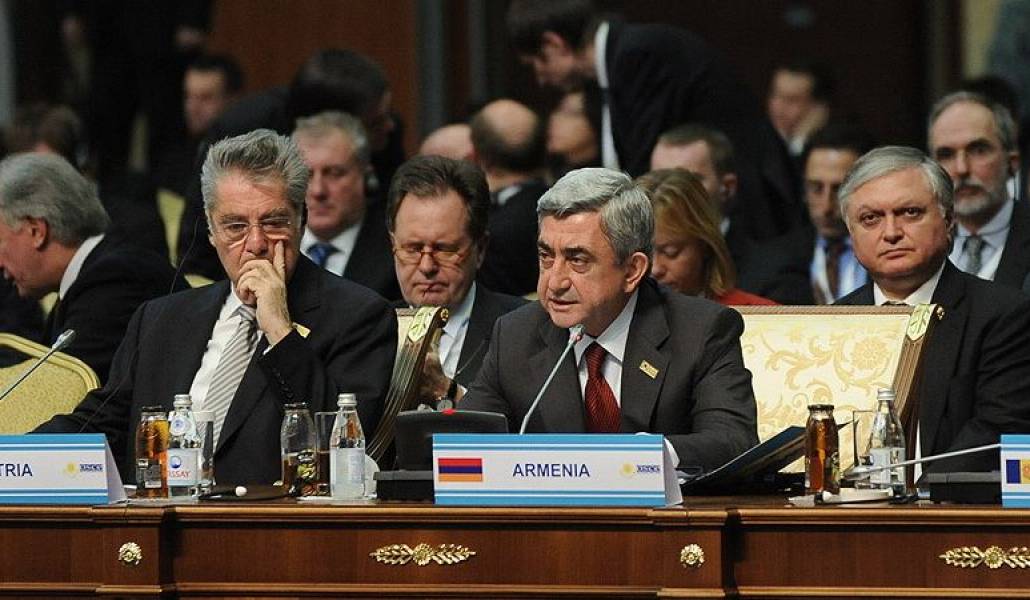
Speech by Serzh Sargsyan at the OSCE Summit (Astana, 2 December 2010)
Respectable President Nazarbayev,
Respectable Mrs. Chair
Ladies and Gentlemen,
This meeting of heads of states that are members of the Organization for Security and Cooperation in Europe can be considered as unique since it is the first OSCE summit in the 21st century and the first in the post-Soviet territory. I congratulate my colleagues of Kazakhstan and personally Nursultan Nazarbayev for the active presidency and for holding a summit at a high level.
The peoples living in the OSCE territory are consistent with the total application of principles included in the Helsinki Final Act with hope and expectations. One of those peoples is the people of Nagorno-Karabakh, which can also expect the realization of the same principles and obligations that are universal regardless of the size of a country, the number of its population and natural resources.
In September 1991, Nagorno-Karabakh declared its independence, followed by an independence referendum in December 1991, which fully corresponded to the norms of international law and the legislation of the Soviet Union existing at the time. The collapse of the USSR led to the formation of two equally legal state entities, including the Republic of Azerbaijan and the Nagorno-Karabakh Republic.
In response to Azerbaijan's policy on ethnic cleansing and an armed aggression against the self-determined Karabakh in 1992, being unrecognized, yet legitimate, Nagorno-Karabakh was imposed to defend itself to save the people facing the danger of elimination and that self-defense fully corresponded to the norms of international law.
Not reaching the goal of eliminating Armenians of Nagorno-Karabakh through military operations, Azerbaijan was forced to sign a trilateral ceasefire agreement with Nagorno-Karabakh and Armenia in May 1994. The ceasefire could have become the start of the establishment of long-term peace emanating from the interests of nations in the region.
However, under the veil of negotiations in the past 16 years and contrary to the Minsk Group's efforts, Azerbaijan took advantage of those years to prepare for a new military venture. Baku thinks the cause and effect of the Karabakh conflict have been forgotten. As Azerbaijan speaks about the need for the return of territories under the control of Nagorno-Karabakh's self-defense army, it forgets that it is impossible to eliminate the effects of its own aggression without eliminating the cause of the conflict.
Ladies and gentlemen,
As far as I know, Azerbaijan is the only country in Europe that proudly speaks of the multiplication of its military budget. Not only are necessary measures not taken against the violation of permissible borders for regular arms, but there is also a new type of arms sale, including by the OSCE-member states. This adds to the Azerbaijani authorities' overtly anti-Armenian speeches and calls that instill hostility, aggression and violence. It has come to the point where Azerbaijani officials don't miss any opportunity to say that Armenia's capital Yerevan is located in the so-called "historical Azerbaijani lands".
Recently, they were disputing the copyright of cross-stones and claiming that the cross-stone is nothing more than a sample of Azerbaijani art. This sparks doubt over the elimination of one of the largest monuments of that art, that is, the Armenian medieval cemetery of Jugha. In our days, this became the peak of the longstanding and consistent policy on eradication of Armenian cultural heritage in Nakhichevan, which has autonomy at the highest level in Azerbaijan.
Dear colleagues,
Azerbaijan's attempts to receive unilateral concessions through the threat of force are not only doomed to fail from the start, but remain the main obstacle for resolving the conflict through mutual concessions as well. In the past week, I was once again convinced that in this stage, Azerbaijan is not interested in settling the Nagorno-Karabakh conflict and its only goal is to harm Armenia as much as possible.
Armenia is absolutely against the restart of military operations in Nagorno-Karabakh. If Azerbaijan restarts military aggression, Armenia will have no other choice but to recognize de jure the Nagorno-Karabakh Republic and put in all its efforts to ensure the security of the people of Artsakh.
The future of Nagorno-Karabakh is not as a part of Azerbaijan. Regardless of how the conflict is resolved, it has to emanate from the will of the people of Karabakh. That is the pivot of the right of nations to self-determination.
Dear colleagues,
The OSCE Summit is itself important for further activities of the organization. I would like to emphasize the OSCE chairing country Kazakhstan's great contribution to turning this long-anticipated meeting into a reality and for holding it at a high level.
Thank you.