"We shall not raise a white flag"
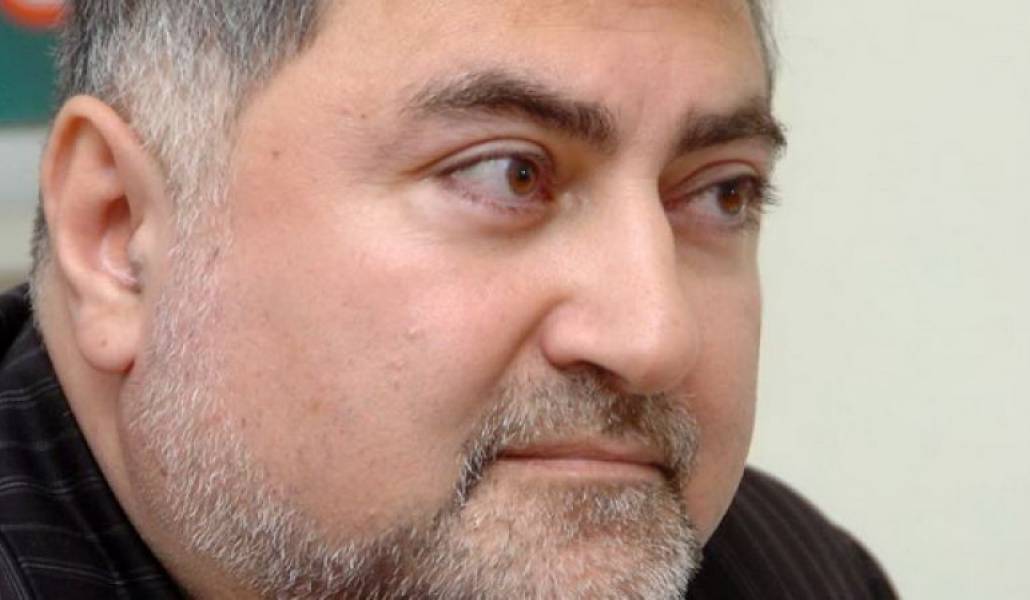
Head of the Modus Vivendi Center Ara Papian, has sent an open letter to the Turkish Foreign Minister Ahmet Davutoglu, in which he criticized the recent statement of the Turkish FM in the Turkish Parliament. The letter says in part:
"I read with interest the text of your speech of the 21st of October at the Grand National Assembly of Turkey. My impressions were mixed. However, I mainly felt that you wished to present what was desirable, instead of what was real.
To begin with, it was astonishing to hear of "occupation" from the foreign minister of a country which has itself been occupying 37% of the territory of Cyprus for more than three decades now, not to mention three-fourths of my homeland - the Republic of Armenia - for almost nine decades. I would like to stress that I am not referring to some abstract "Armenian lands", but solely the territory granted to the Republic of Armenia through a document of international law, that is, the arbitral award of US President Woodrow Wilson of the 22nd of November 1920. I shall elaborate on the arbitral award later, but for now I would simply like to say that, in accordance with international law, arbitral awards are "definitive and without appeal."
While commenting on the fifth clause of protocol on the establishment of diplomatic relations between the Republic of Armenia and the Republic of Turkey, you drew the conclusion that the Republic of Armenia recognises "the existing border" according to the treaties of Moscow (of the 16th of March 1921) and Kars (of the 13th of October 1921).
This is a very arbitrary conclusion indeed. The document in question does not cite the aforementioned so-called treaties. The protocols refer only to "the relevant treaties of international law". That is, evidently, the treaties in question must be governed by international law, at the very least not being in violation of it. Simultaneously, by referring to "the relevant treaties of international law" and not simply "international treaties", the protocol provides a more inclusive definition, and thus brings in "the instruments of international law" in general, regardless of the kind of document, as, given the present case, we have a document known as a "protocol". Accordingly, a "treaty" must be understood in a way separate from the term for the document, purely as a legal, written international agreement. ["Treaty" means an international agreement concluded between States in written form and governed by international law - Article 2.1(a), Vienna Convention on the Law of Treaties, 1969].
Do you really believe that two unrecognised, and consequently illegal self-proclaimed administrations, as the Bolsheviks and Kemalists were in 1921, could, through a bilateral treaty (of Moscow), nullify a legally negotiated international document signed by eighteen recognised states (the Treaty of Sèvres)? Do you believe that the Molotov-Ribbentrop Pact, for example, is a legal document? I do not think so, because two countries, namely the USSR and Germany, could not decide the borders of a third country. Then why do you believe that two rebel movements, as, I repeat, the Bolsheviks and Kemalists were in 1921, had the authority to decide in Moscow the borders of some other country, the Republic of Armenia, even if it were occupied?
We - the Armenians and the Turks - are condemned together to find mutually acceptable solutions. Such solutions may come in many forms, but one thing must be clear, that they have to benefit the establishment of a stable peace for the entire region, the development of a diverse economy, the creation of a co-operative atmosphere, while serving as well the realisation of certain interests of global powers and their greater inclusion in regional issues. And so, that solution must be such that it dispels the security concerns of the Armenian side, while providing conditions of sustained economic growth and development for the Republic of Armenia, as well as guaranteeing the preservation of Armenian cultural values. Simultaneously, the solution must not go against the core interests of Turkey, and the proposal must be appreciable by the Turkish side as a dignified solution to the given circumstances.
We are willing to co-operate, but do not take that as a sign of weakness and do not force us to raise a white flag of surrender. That will never occur."