AN INTERVAL IS ANTICIPATED IN THE NEGOTIATIONS
Support A1+!The OSCE Minsk Group Co-Chair Mathew Bryza announced the principles of settlement of the Karabakh issue discussed by the presidents of Armenia and Azerbaijan. These principles include withdrawal of Armenian troops from the territories, where they were stationed, economic assistance to Karabakh and communication, as well as a referendum on the status of Nagorno Karabakh at some stage.
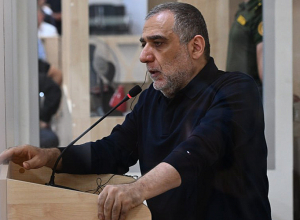
“For the first time a co-chair presented systematically all the information that is possible to get from various sources,” Vahram Atanesyan, Chair of the Committee of External Relations of the NKR National Assembly, said to the Karabakh Open. He emphasized that the proposals of the American co-chair are not in the interests of Karabakh. According to Atanesyan, opening the cards is an effort to make pressure on the parties. “Otherwise, the presidents might reach agreement. Besides, agreement without the engagement of the government of NKR is impossible,” said Vahram Atanesyan. “Unfortunately, it seems to me that the principles of settlement of the Karabakh issue, “revealed” by the OSCE Minsk Group Co-Chair Mathew Bryza, are addressed to the Armenian public because they are in the interests of Azerbaijan,” said Vahram Atanesyan. “In particular, the return of territories and uncertainty over the time of settlement of the problem of status,” said Vahram Atanesyan.
“I think opening the cards at the moment means there are major controversies and hurdles in the process of settlement. Moreover, these hurdles are impossible to take. Therefore, the cards were opened in the summer of 2006, which was said to be an expedient year for the settlement of the Karabakh problem. It means that the talks did not produce significant results,” Davit Babayan, political scientist, said to the Karabakh Open.
“The logic of Azerbaijan and certain international organizations, namely the return of territories and holding a referendum at a period which is uncertain is unacceptable for the Armenian party. Some liberated areas have the same role for the security of Karabakh as the independence. Real independence is impossible without these areas. For instance, 85 percent of Karabakh rivers, as well as the rivers Vorotan and Arpa nourishing the Sevan start from the region of Karvachar. If this area is not controlled by NKR, Karabakh may undergo ecological terror. Even if the independence of Karabakh is recognized. However, Azerbaijan rejects this as well, and insists on maintaining the status of Karabakh in an indefinite period of time. If the developments follow this path, it may be a powerful psychological shock for the people of NKR, and it will be difficult to get over it. It is absolutely absurd for a winner to take such a step,” said Davit Babayan.
“What is more, both the independence and autonomy of Karabakh contain equal risk for Azerbaijan, because in both cases the other ethnic minorities in Azerbaijan, namely the Talish and Lezgis will demand similar rights. And this could lead to the dissolution of the Azerbaijani statehood,” noted the political scientist.
The “proposals” revealed by the new American co-chair of the OSCE Minsk Group Mathew Bryza did not find support in Karabakh. The chair of the Committee of External Relations of the NKR National Assembly Vahram Atanesyan, Democracy faction, Gagik Petrosyan, representative of the second political party in the parliament Azat Hayrenik, and the opposition announced that the package discussed by the presidents of Azerbaijan and Armenia is against the vital interests of Karabakh. The proposals on returning territories and holding a referendum in an indefinite period are unacceptable. “The impression is that the revelations were addressed to the Armenian party because they are totally in the interests of Azerbaijan,” said Vahram Atanesyan.
At the same time, they think in Karabakh that Bryza’s revelations may be a swansong of the package proposal. Political scientist Davit Babayan thinks that since the proposals have been published, the presidents will not discuss them, and a necessity for new approaches will occur.