"Protocols are already exhausted"
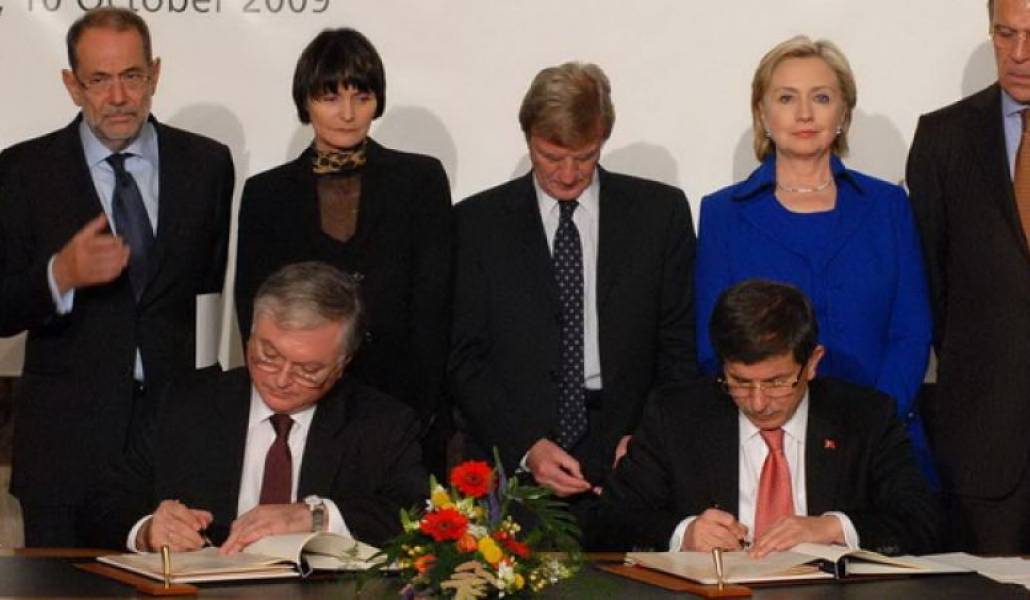
On October 10, 2009, in the Faculty of History at the University of Zurich, the foreign ministers of Armenia and Turkey signed a diplomatic agreement - consisting of two protocols - to establish normalized diplomatic relations between the two countries.
The ceremony, scheduled for around 8 p.m. (Yerevan time) was delayed for 3,5 hours. This was an unprecedented phenomenon in the history of diplomatic relations as the sides usually put their signatures on documents after clarifying all doubtful questions.
Later it was told that the signing ceremony was delayed as the Armenian delegation objected to a statement that the Turkish side wanted to add to the proceedings. It was widely believed that the statement was intended to link the Nagorno Karabakh settlement to the rapprochement process - a condition the Armenians have objected to from the start of negotiations.
Neither side issued a statement following the signing as had initially been planned, an idea apparently scrapped as a consequence of the dispute that led to the signing delay.
In reply to the tension of Armenian Foreign Minister Edward Nalbandian, who was putting his name on the documents, Turkish FM Ahmet Davutoglu gave a ghastly smile.
Following the ceremony, hundreds of thousands of Armenians spoke against the protocols. A number of opposition and nationalist forces vehemently criticized the documents, citing its prerequisites.
A joint headquarters was formed which regularly organized protests and marches against the controversial document. The Armenian Revolutionary Federation-Dashnaksutsyun even demanded the resignation of the Foreign Minister and held a sit-in protest.
The wave of protest calmed down when the Constitutional Court of Armenia dismissed the outrage over the preconditions, thereby excluding or minimizing the speculations voiced by the Turkish side.
Following the events, the protocols were withdrawn from the agenda of the Turkish Majlis. However, the parliamentary groups of the Armenian Revolutionary Federation-Dashnaksutsyun and Heritage continued to demand the Speaker of the Armenian National Assembly to remove the documents from the agenda.
Armen Martirosyan, who headed the Heritage faction in 2009-2010, says their demand is still in force. "The earlier Armenia withdraws its signature, the better for the country as we see that Turkey is continuing its non-friendly relations. If earlier they displayed a neutral posture in the Karbakh issue, today Turkey demands that Armenian withdraw its troops from the liberated territories," he said.
On April 22, 2010 Serzh Sargsyan eventually declared his decision to freeze the reconciliation process as long as Turkey did not decide to ratify the protocols.
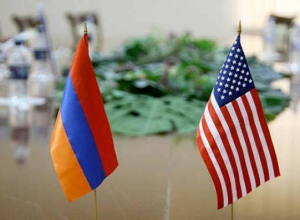
U.S. Secretary of State Hillary Clinton announced in Armenia that ‘the ball is in Turkey's court.'
Artak Zakaryan, Chairman of the NA Standing Committee on Foreign Relations, says the international community unanimously hailed the protocols and still has a good opinion of the document as it focuses on ensuring long-term stability in the region.
Armen Martirosyan is convinced that Armenian authorities do not want to withdraw the protocols from the agenda in order to avoid further problems with their foreign partners, who can, in their turn, create internal problems for the authorities.
Artak Zakaryan believes that any reference to the protocols can only have a positive impact on Armenia's reputation. "Our future steps depend on Turkey," he said.
Mr Martirosyan thinks that Armenian should get rid of the protocols as quickly as possible as the protocols are already exhausted.