Speech by Levon Ter-Petrosyan
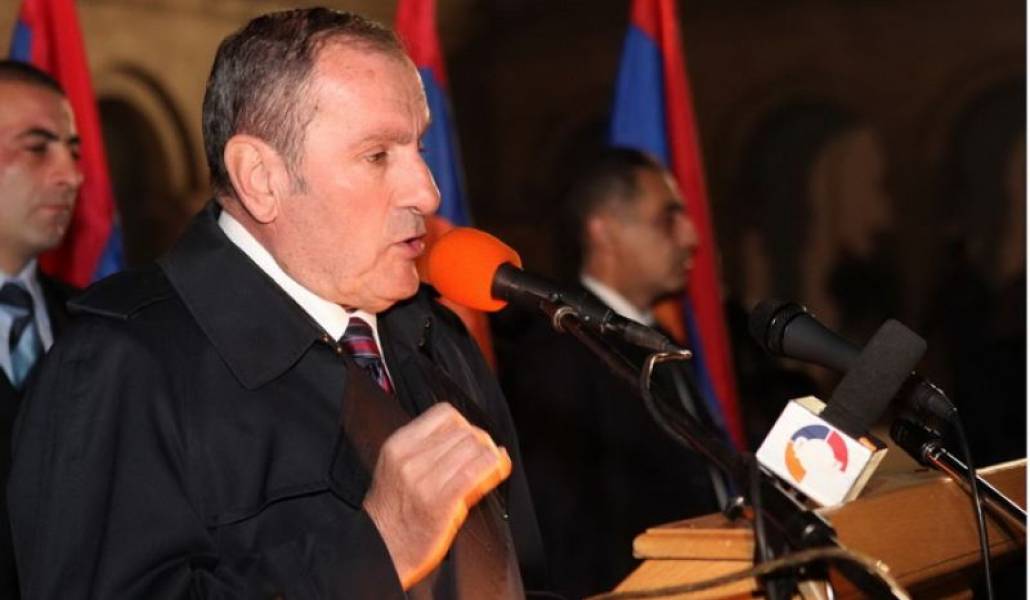
Dear fellow Armenians,
Since today's rally was convened on the occasion of the human rights seminar taking place in Yerevan within the framework of the "EU-Armenia Dialogue", the main topic of my speech will be the issue of political prisoners again. Perhaps this is the most appropriate occasion to finally clarify the Armenian National Congress's position on that issue.
Some think that the Congress is making efforts to have European officials pronounce the word "political prisoner" for the oppositionists in prison. The Congress has never set such an objective because the international community recognized our friends as political prisoners a long time ago. In the three announcements of the European Union (4.03.2008, 12.03.2008 and 10.03.2010), they are called "detained in connection with their political activities" and in Resolutions N1609 and N1620 of the Parliamentary Assembly, they are "detained on artificial and politically motivated charges". In addition, the PACE Resolution 1609 characterizes the persecutions by the Armenian authorities as a "de-facto crackdown on the opposition by the authorities".
In this sense, what's interesting is the fact that all the above mentioned documents of the European Union's presidency and the PACE demand or call on the release of the oppositional prisoners of Armenia. According to a release disseminated by the U.S. Embassy in Armenia, U.S. Secretary of State Hillary Clinton had the same demand during her visit to Armenia and "expressed the conviction of the U.S. government that the issue of the 13 prisoners requires a swift solution". If those 13 individuals weren't considered as political prisoners, why would the international community demand their immediate release?
Recording the presence of political prisoners is one side of the issue. The other, more important side is the international community's necessary efforts in releasing the prisoners. However, the former is lagging behind. Of course, the main reason is geopolitical considerations, particularly the expectation of getting something from the Armenian authorities in terms of Armenian-Turkish relations and the Karabakh conflict settlement.
There are also corporative interests and the factor of bureaucratic interests within international organizations. Of course, the European officials are not inclined to confess their geopolitical considerations, as well as the bureaucratic and corporative interests. Instead, they try to justify their flaws in protection of human rights and establishment of democracy through the explanations such as "the functioning of democracy is a long-term process", "Armenia is democratically in a better situation than, say, Afghanistan", "it is dangerous and inefficient to allay authoritarian regimes and apply sanctions against them", "international organizations cannot intervene in the member-countries' internal affairs, much less be involved in changing a regime" and "both the Armenian authorities and the opposition complain about the activities of international organizations, particularly the Council of Europe".
It is worth touching upon the positions of Armenian bureaucrats, particularly Head of the NA Standing Committee on State-Legal Issues at the National Assembly David Harutyunyan and RA Ombudsman Armen Harutyunyan on political prisoners and the protection of human rights. David Harutyunyan has solved the issue of avoiding the application of sanctions against the dictatorial regime that he represents and has played a role in setting more limits on democracy and deepening violations of human rights. The regime owes it to David Harutyunyan for its existence after all the humiliation and failures.
However, Armen Harutyunyan is another story. Instead of opposing the government in terms of human rights protection, he has taken on the role of justifying the government's illegal actions and crimes and still hasn't defined a political prisoner is. Commenting on CE Secretary General Thorbjorn Jagland's statements in Yerevan, Armen Harutyunyan said Yagland had not specified who political prisoners are and how it is determined whether they are political prisoners or not. As far as the prohibition of rallies is concerned, both express the same positions. Armen Harutyunyan says that the European Convention and the precedent of the European Court of Human Rights say that the authorities can reject the opposition in case of reasons, but the rally must not be far from the same place. David Harutyunyan says something similar and simply adds that the authorities can offer another site.
First, the European Convention and international practice refer to exclusive cases of prohibition, but that takes place systematically in Armenia. Secondly, according to Point 4, Article 13 of the RA Law on "Meetings, Rallies, Marches and Demonstrations", the authorities are "obliged" to offer other dates for the event in the "same place", but the authorities don't want to do that. Thus, the prominent lawyers are either unaware of these primitive truths or they are simply lying and confusing the people. This was an occasion to tell those men the truth. I couldn't resist the temptation and took advantage of this opportunity.
I'm sliding a little off topic, but I also had to speak about Serzh Sargsyan's speeches. In his speech at the media forum, Serzh Sargsyan counterattacks Azerbaijan's state policy and "brilliantly" proves that there is anti-Armenian fascism in Azerbaijan, the Azerbaijani are not a nation, they don't know what their religion is, while the Armenians have a history that spans over 8,000 years. What can I say, this significantly favors the reconciliation between Armenia and Azerbaijan and the settlement of the Nagorno-Karabakh conflict. Let's hope that the international community will give an adequate evaluation of this.
In his second speech, better yet, press conference, Sargsyan touched upon the defective phenomena in the army, particularly the killings, suicides and tortures and instead of talking about the need to eradicate those defects and bringing those responsible to justice, he deemed it necessary to express his negative views on those who revealed and criticized the phenomena. From the political angle, we are dealing with a very dangerous reality because by this, Serzh Sargsyan is promoting the horrible crimes in the army and is encouraging the continuation.
I would not like to discuss the disputed revelation of Joe Biden according to which Serzh Sargsyan had called him and asked that the U.S. government put an end to the recognition of the Armenian Genocide in order not to harm the negotiations on the Armenian-Turkish reconciliation. There is no need to go further because on the one hand, I don't believe Sargsyan could go that far, but on the other hand, if that is the truth, then, as they say, no comment. As far as the October 27 Medvedev-Sargsyan-Aliyev meeting held in Astrakhan is concerned, that only confirms my claim that even in the presence of the Minsk Group, the main processes for the Nagorno-Karabakh conflict settlement are taking place in a totally different format.
Thank you for your attention and I wish us all a good march.