Will the EU bring protracted peace to the South Caucasus?
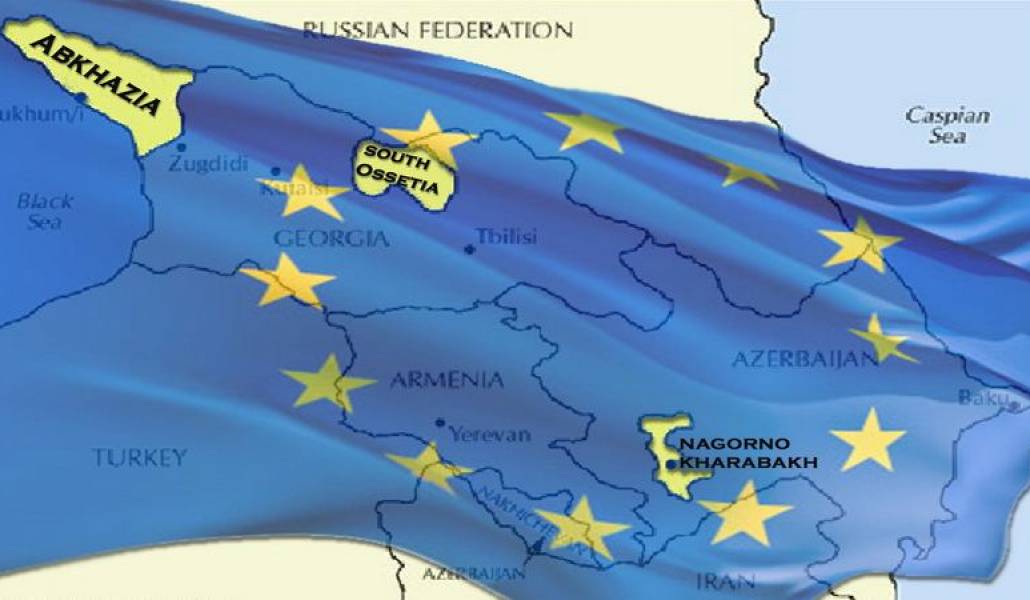
While the European Union (EU) is signing Association Agreements with Armenia and Azerbaijan, official Yerevan remains silent.
Neither the inter-departmental commission coordinating the cooperation between Armenia's state bodies and EU structures nor the Ministry of Foreign Affairs has given an official answer, but an official from one of the aforesaid departments gave an answer under the condition that the source remains anonymous.
"Armenia is interested in seeing direct contacts between the EU and NKR and the implementation of development programs for the needs of the NKR. I think the European Union will see the necessity sooner or later, as well," as stated in the written response.
The talks on the European Union Association Agreement with Armenia will launch on July 19 in Yerevan and talks with Azerbaijan and Georgia are scheduled for mid-July (in addition to the three South Caucasus countries, Ukraine, Belarus and Moldova are also included in the Eastern Partnership program).
Although the European Union is not directly engaged in the settlement of frozen conflicts in the region, a couple of days ago, on July 8, EU Special Representative in the South Caucasus Peter Semneby announced that the settlement of those conflicts is still a priority for the European Union.
Considering unresolved conflicts as the number one threat to regional stability, Peter Semneby viewed the Karabakh conflict as troubling because "fatal incidents are taking place on the line of contact."
The agreements to be signed presume deepening of political dialogue between the European Union and South Caucasus countries and deeper economic cooperation.
Will the Agreements serve as an impetus for settling the frozen conflicts?
In response to "A1+"'s question, neither Armenian, nor Azerbaijani nor Georgian experts gave a positive answer.
A look from Yerevan
Head of the "International Center for Human Development" Tevan Poghosyan believes that the Agreements will serve as an impetus only when the EU begins to implement concrete programs in Abkhazia, South Osetia and Nagorno-Karabakh to show its power and influence.
According to Mr. Poghosyan, the old formulations will most probably be stated in the Agreements, that is, it will be stated that "there exist unresolved conflicts and the European Union calls on settling them in the near future."
He says no financial offer can lure the sides for a quick settlement of, for instance, the Karabakh conflict as long as the parties haven't found a solution to the issue.
"Azerbaijan's profits are enough for the country not to need financial aid from the EU at all," says the political scientist. As for Armenia, "Karabakh will always be worth more than any sum."
The political scientist presumes that the "black spots" of the South Caucasus won't become members of the EU Association Agreements as long as they remain unrecognized.
A look from Baku
"All republics of the South Caucasus will self-willingly take the responsibility for peaceful settlement of conflicts, that is, all provisions for integration into the Council of Europe will simply be transferred to the EU Association Agreements. The changes may be merely stylistic," says Azerbaijani political scientist Arif Yunusov.
Time has shown that integration into the European Union has no impact on the settlement of conflicts and that will be the case after the signing of the EU Association Agreements as well. According to the political scientist, the processes taking place in each republic and the foreign factors must be taken into account when settling the conflicts. The foreign factors always depend on the interests of the "huge players" which don't always match. However, "the EU Association Agreements will allow finding new approaches for settling the conflicts."
"The frozen conflicts in the South Caucasus and undemocratic governance are like mosquitoes swarming and biting people in the summer. But can the conflicts become a disturbing circumstance for tranquility in the region? It will be that way later as well...," says Arif Yunusov.
According to Yunusov, the EU will stay content with the fact that the conflicts don't turn into military operations. As far as undemocratic governance is concerned, European organizations will criticize from time to time, while local authorities will take them into account and Europe will "talk about the achievements in the development of democracy in the South Caucasus."
Arif Yunusov thinks the "South Caucasus republics are not of any interest to the EU."
According to him, the South Caucasus has sparked the EU's interest from two angles - a passage linking the West and East and an energetic resource. The interest grew especially after Russia's gas threat when Eastern Europe was forced to find alternative means.
A look from Tbilisi
Georgian conflictologist Paata Zakareshvili believes that the EU Association Agreements will not have a direct impact on the settlement of conflicts in the South Caucasus, but there will definitely be an indirect impact. According to him, since European organizations are involved, the South Caucasus countries will be more obliged to settle the conflicts peacefully and stay in line with European standards and assignments.
He believes that the "black spots" will appear in the Association Agreements with the following status: "For instance, Karabakh will be included as a part of Azerbaijan, while Abkhazia and Osetia will be included as parts of Georgia." (In other words, this means the repetition of what was registered during integration into the Council of Europe when Azerbaijan became a member of the CE by presenting Nagorno-Karabakh as its territory, while Nagorno-Karabakh had already declared its independence 10 years before that-ed.).
"However, it will be impossible to carry out the agreements in these territories because the legislation of Azerbaijan or Georgia doesn't refer to them," says the conflictologist.
He stresses that the EU will help settle the conflicts, but the countries themselves must carry them out.
Reference to the official source
"In the political section of the agreement, we can address the sides' efforts to maintain peace and stability in the South Caucasus, the peaceful settlement of conflicts and the encouragement for cooperation and mutual confidence. If each partnering country makes a commitment to guide by the principle of peaceful coexistence when settling the existing conflict, that will be a notable contribution to the settlement of conflicts. In this context, we should not overestimate any one agreement or initiative that is not a result of an agreement between the conflicting sides. In that sense, the existing format of negotiations is more important," an official anonymous, but reliable source told "A1+".
Karine Asatryan